
7 Ways to Beat Bloating


Not so fun fact, between 15–30% of Americans have experienced bloating. Thus, be rest assured that you are nowhere near alone in this. You are not the only one out there inflating like a balloon after your meal. So, what can you do to deflate yourself back to the norm?

Contents
Eat at the Right Times
Stop the late-night snacking. Our human bodies follow a “biological clock” where after 7 PM, digestive enzymes maximally decrease. These enzymes are the proteins that are responsible for splitting up large food molecules into their ‘building block’ components. So to ensure smooth digestion, you should plan to eat three small portion meals only during the daytime, within a 10 to 12-hour window, 3 to 4 hours apart.
Chew Your Food Well
Slow down and chew your food intentionally. 32 is the estimated number of times you should be chewing on your food before swallowing it. This helps ensure that food is broken down until texture is lost, making it easy for your body to digest and absorb as many nutrients as possible from your meal.
Eat More Healthy
Cut out the junk. For many, changing the diet is the hardest part. Today’s world is full of refined carbohydrates, processed foods, sugar, and food additives that we all are bound to crave. However, a nutritious and high-fiber diet will help keep the delicate microbiome bacteria balanced.
Here are some suggested changes to the diet that will assist in keeping the digestive processes well regulated and running smoothly:
- Stop eating all highly processed foods.
- Avoid bread products containing yeast.
- Remove sweet carbonated beverages.
- Avoid dairy products.
- Don’t eat cruciferous vegetables, such as broccoli, cauliflower, etc.
- Stop alcohol use.
- Remove sugar.
- If needed, use plant-based Stevia for sweetener.
- Include some healthy fats.
- Drink more water or unsweetened herbal tea.
- Include lean proteins in your diet.
- Eat more fiber.
- Include probiotics.
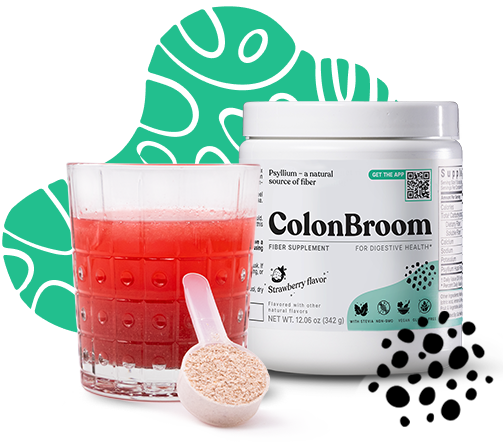
You may also like to try cleansing your body safely and effectively with ColonBroom.
See how it can help. Take a quiz.
Drink More Fluids
Let’s face it, it is so much more satisfying to drink something more flavorful than just plain old water. Sadly those sugary pop drinks or that whipped cream caffeine-filled latte won’t hydrate you. The truth is that more than half of adults in the United States can be considered chronically dehydrated.
For our bodies to stay hydrated, it is recommended to consume 2 to 3 liters of water a day. Now, this may seem like it’s a lot, but there are plenty of ways to make water not so dull while still keeping it the healthy and hydrating choice.
Try some of these flavors or unsweetened herbal teas alone or mix and match them to taste:
- Lemon
- Cucumber
- Honey
- Ginger
- Cinnamon
- Peppermint
- Lemongrass
- Wormwood tea
- Chamomile tea
- Nettle tea
- Cumin tea
Keep a Food Journal
Everyone’s system is different. For example, some may have where some may not have problems digesting dairy products. This is why keeping tabs on what you eat is a great idea. Whether you want to neatly note and plan your meals ahead or just quickly jot down what you had after eating, writing down what you ate and how you felt that day could be pretty helpful. After some time of keeping track, patterns will become visible, and the causes of any digestion discomforts will become easily identifiable. You can then use all that info to adjust your diet and reduce bloating.
Go for a Walk or Workout
You just ate, and taking a nap may sound fantastic right about now. Don’t do it; go for a walk or exercise instead. The built-up gas needs to move through your digestive tract to decrease your bloat. Simply walking for 10 to 15 minutes will help. Abdominal muscle strengthening exercises can also help bust your bloat. Whatever you do, just keep moving.

Relax and Avoid Stress
Take a deep breath and relax. Healthy digestion is turned on to its fullest when the brain is in relaxation mode. Staying calm before eating allows the production of adequate digestive enzymes, in turn letting the parasympathetic nervous system work the way it is supposed to.
Meanwhile, stress can be accompanied by bloating and many other irritating and uncomfortable symptoms. It may even trigger the “Fight or Flight” response, and this is no good for digestion. The survival mode works solely to ensure our survival. Thus, blood is shunted to the muscles and the brain, as digestive system functions are slowed, for they are not seen as essential.
Here are some ways to clear your mind, boost your metabolism, and beat bloating:
- Yoga
- Mediation
- Warm bath
- Essential oils
Wrapping Up
If trying these methods does not help and symptoms are prolonged, contact a medical professional. There are underlying conditions such as Irritable Bowel Syndrome (IBS) that may be causing your digestive problems.
Related articles
Metabolism Boosting Foods That Actually Work (And Ones to Skip)
Your body burns calories all day long, even when you are doing nothing more exciting than scrolling on your phone. That calorie burn is your metabolism at work. Genetics play a role in how fast or slow your metabolism works, but what you eat plays a role too, and so does how you sleep, move, […]

Period Cravings: Why Your Body Wants All the Snacks (And What Actually Helps)
If you have ever stood in front of the fridge a few days before your period, completely convinced that only a block of cheese and a chocolate bar could fix your mood, you already know what period cravings feel like. One week you eat a salad without a second thought. The next week you would […]

Food Cravings Meaning: What Your Body Is Really Trying to Tell You
Food craving refers to that sudden pull toward one specific food, and it can feel almost impossible to ignore until you give in. Here’s the interesting part. Your cravings are not random. They often carry a message about what’s going on inside your body or your mind. Learning the meaning behind your urges can help […]
Subscribe to our newsletter!
Curious to know what your number two says about your health? Get juicy info and top-notch advice on tummy health, boosted colon tips, and more by joining the wondrous world of ColonBroom newsletters.
By providing your email address, you agree with the T&Cs and Privacy Policy



Take a quiz and get your personalised solution.